Residential spider activity in Stockton spikes during warm summers and late autumn transitions, driven by agricultural proximity, waterways, and foundational microclimates. Properties adjacent to the California…
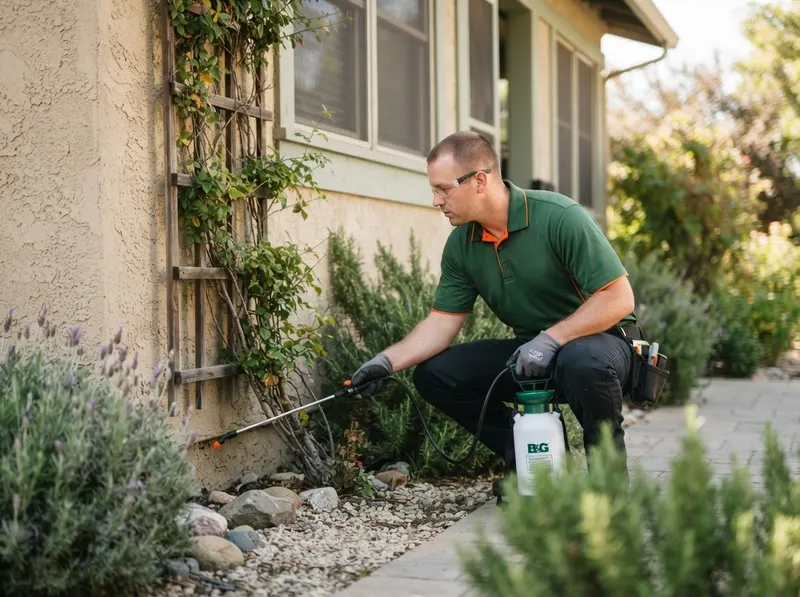
Residential spider activity in Stockton spikes during warm summers and late autumn transitions, driven by agricultural proximity, waterways, and foundational microclimates. Properties adjacent to the California Department of Water Resources levee networks near Weston Ranch, Brookside, and Country Club experience dense midge and fly populations, which naturally pull predatory arachnids toward soffits, weep holes, and patio enclosures. A professional treatment addresses this food supply directly while establishing physical barriers. Mechanical sweeping reaches up to 25 feet into exterior rooflines to dismantle silk structures and destroy silken egg sacs before secondary spiderling dispersals occur into interior living spaces.
Treatment strategy hinges on building architecture and species behavior. Modern stucco slab foundations in Spanos Park and Lincoln Village require precision injections along perimeter expansion joints, whereas older raised foundations in Sherwood Manor or near the Pacific neighborhood require crawl space vapor-barrier checks and perimeter vent screening. Western black widows (UC IPM guidelines classify Latrodectus hesperus as an entity of concern) gravitate toward dry, undisturbed crawl spaces, meter boxes, and garage framing. In contrast, common wolf spiders and ground runners penetrate door thresholds and subfloor plumbing penetrations. Implementing strict mechanical exclusion using non-corrosive copper mesh alongside low-toxicity microencapsulated botanicals compliant with the California Department of Pesticide Regulation creates lasting protection without volatile indoor chemical residues.
Homeowners weighing a one-time treatment against quarterly barrier maintenance must evaluate exterior landscape density. A standalone targeted application clears an active infestation, but properties surrounded by irrigated orchards in Morada or dense riparian corridors along the San Joaquin County delta face perpetual reinfestation from wind-borne dispersal, known as ballooning. Ongoing seasonal applications reinforce the perimeter before seasonal temperature drops push outdoor spiders toward heated wall cavities. Standard service protocols adhere to pest management environmental safety frameworks regulated by the US Environmental Protection Agency, the structural safety criteria enforced by the California Structural Pest Control Board, and property sanitation guidelines from the San Joaquin County Public Health Services. Integrated pest management protocols also align with national standards established by the National Pest Management Association, safety recommendations outlined by the National Institute for Occupational Safety and Health, and habitat classifications documented by the California Department of Fish and Wildlife.
Every job gets a firm, written price after a free on-site visit.
For standards, safe disposal, and service guidance on PEST CONTROL SEVICE in Stockton, CA, useful references include U.S. EPA, ENERGY STAR, U.S. Dept. of Energy, Consumer.gov, U.S. Census Bureau, and Google Maps. General consumer and small-business resources are available from USA.gov, Better Business Bureau, FTC Consumer Advice, U.S. Small Business Administration, and Ready.gov.
Tell us about your spider control job in Stockton and we'll send a clear, written quote, usually the same day.
 SilverOak Pest Solutions